C.J. Paul has seen a lot through the years. As manager for his
brother Chris' basketball and business interests, he was there when the
Hornets relocated to Oklahoma City for the two years after Hurricane
Katrina struck New Orleans. He was there when the NBA took control of
the team a few years later, after owner George Shinn could no longer
afford it. And he was there when former commissioner David Stern vetoed his brother's trade to the Lakers and "a week later you're going to the Clippers," he remembers with a smile and a shake of his head.
But nothing could have prepared him for what happened last
weekend in San Francisco. Like many people close to the Clippers, Paul
had heard on Thursday that TMZ was about to run a story that would be
very damaging for team owner Donald Sterling. Nobody quite knew what was
in the story, or just how bad it would be, but it was dropping soon,
playoffs be damned. Had Sterling said something embarrassing or racially
insulting again? Was it an affair or some kind of sex scandal? Was it
another case of his not paying one of the coaches or general managers
he'd fired in the past? Perhaps a hidden debt had surfaced -- one
staffer tells a story of the time the Clippers' old practice facility at
L.A. Southwest College had been locked up because Sterling hadn't paid
rent in so long.
When you play for the Clippers, you learn to live with Sterling
and his history. You tell yourself you play for the city of Los Angeles,
your teammates and the fans. He's the guy who signs the checks, and
hopefully stays out of the way. It doesn't always sit well. Your
stomach's never really settled. But over time the queasiness either goes
away or you shove it down deep and resolve to deal with it later.
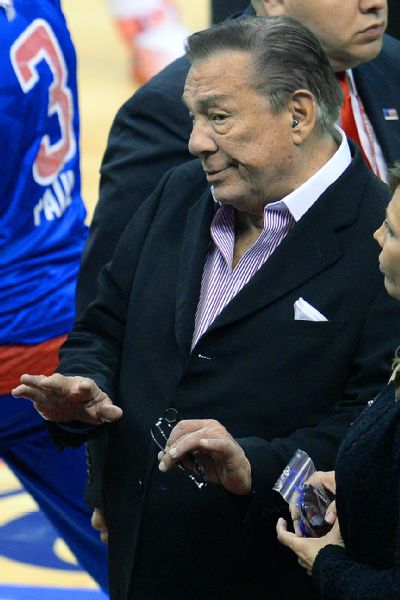
Robyn Beck/AFP/Getty ImagesIn the wake of Donald Sterling's racist comments, the Clippers organization was in turmoil.
C.J. Paul was in his room at the Four Seasons in San Francisco on April 25 when the Sterling story broke around 10 p.m. Chris Paul
was across the hall, in his room, getting ready for bed. The Clippers
had an early practice scheduled in the morning. But this couldn't wait.
C.J. called his brother and told him he needed to read the story
immediately. There, for the world to see and hear, were transcriptions
and audio recordings of Sterling articulating an archaic, racist
worldview to a woman named V. Stiviano. (She'd once introduced herself
to C.J. as Sterling's assistant.)
"It bothers me a lot that you want to broadcast that you're
associating with black people. Do you have to?" Sterling asks the woman.
"You can sleep with them. You can bring them in, you can do whatever
you want. The little I ask you is not promote it ... and don't bring
them to my games."
"When we first came here, we'd heard stories," C.J. Paul said. "But it's one thing to hear stories, and it's another thing to hear them.
"This
is by far the worst, of everything that's happened to us in the last
nine years. Katrina, living in Oklahoma City for two years, then the
team gets taken over by the NBA, then you think we're going to the
Lakers and a week later we're going to the Clippers.
"But this... You just never think you have to put up with
something like that... For that to happen is just... That is personal."
'Unless you're in it, you don't know'
Chris
and C.J. didn't sleep much. By Saturday morning, Chris was on the phone
with NBA commissioner Adam Silver and Sacramento Mayor Kevin Johnson,
the acting director of the NBA Players Association. His teammates were
furious - angry at Sterling for what he'd said and also for the way the
news was disrupting their season at its most important moment.
Paul
is a natural leader. Student body president in high school, captain of
every team he ever played on, organizer of his 10-year high school
reunion. If there's a void, he steps into it. But this was too big a rip
in the fabric of the NBA for one man to sew up. And he had a playoff
game in 24 hours. He leaned on Johnson and on his brother for help. They
called an early Saturday morning players meeting at the Clippers' team
hotel. Most of them had barely slept. Players from around the league
were texting them at all hours, telling them what they would do. That
the Clippers should boycott, sit out, protest, anything to express the
collective outrage they were all feeling.
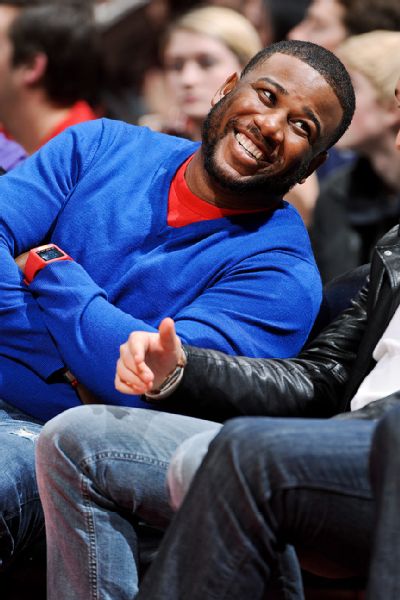
Andrew D. Bernstein/NBAE/Getty ImagesC.J. Paul was a key adviser to his brother, Chris, after Sterling's comments became public.
"I think every player probably got at least one text or one call
that said, 'You guys shouldn't play.' I got texts saying they shouldn't
play," C.J. Paul said. "But my thing is, 'Unless you're in it, you don't
know.'
You don't know, because you haven't been in the fight with the
Clippers all season. Their championship dreams are their own. The peace
they'd all made with playing for and taking a check from Sterling was
their own, too. "They didn't want to not play," one Clippers staffer
said. "They worked their ass off to get there." This was Sterling's
mess, not theirs. Why should they have to throw away their season?
Still,
they couldn't carry on as if nothing had happened. This couldn't be
tolerated. A message had to be sent. For them, for their fellow players
around the league, for anyone, they thought, who has ever felt the
unmistakable blow of racist language. All day Saturday, they held
meetings, some formal, some informal. They texted and called each other.
In between, they held a brief practice at a gym on the University of
San Francisco campus, mostly just to break a sweat and get some shots
up. The one thing they all agreed on was that Clippers coach Doc Rivers
should be their voice.
"They're young men," Rivers said. "It shouldn't be
African-American men. We have two white guys. It's about being human. No
one was happy about it. J.J. Redick was just as pissed as Chris Paul, and that's the way it should be.
"Having said that, our goal is to win the NBA title and we're not
going to let anything stand in the way of that. That's adversity that
we didn't want but we have it and we have to deal with it and we'll deal
with it internally but we're not going to share it with anybody else."

Andy Marlin/USA TODAY SportsAdam Silver's forceful response surprised some and reassured many throughout the NBA.
A commissioner's defining moment
There was no time to prepare for facing the Golden State Warriors
in Game 4 on Sunday afternoon. One player estimated the team spent less
than half an hour discussing the adjustments the players needed to make
from Game 3. Another team insider said it was probably even less than
that.
TMZ cameramen and reporters had swarmed the lobby, having booked
several rooms at the Four Seasons so they could legally be inside the
private property. Outside was even more chaotic. The whole world wanted a
reaction. Clippers team security advised players and staffers to stay
inside their hotel rooms as much as possible. They were on lockdown.
Across the country, Silver was facing his first real crisis since
taking over as commissioner on Feb. 1. A lawyer by trade, his first
inclination was to get all the facts. He was in discovery mode: set your
emotions aside, clear your head, then assess. His mentor and
predecessor, David Stern, was famously hot-tempered and quick to speak.
Silver is different. "Adam's never going to yell," one associate said.
"If his voice raises, it's only for emphasis. Not to yell."
But make no mistake, Sterling's comments had Silver angry. He
might not have Stern's hair trigger, but they share a strong sense of
morality and social justice. This went against all of Silver's
principles. As he would put it later, "I think my response was as a
human being, and I used the word distraught." Within hours, he had
tasked investigator David Anders from the law firm Wachtell Lipton with
authenticating the tapes and gathering information about how they were
made and disseminated. If it was Sterling on those tapes, if they hadn't
been doctored or altered, Silver knew he wanted to punish him severely.
Silver had already planned to travel to Memphis and to speak to
the media there before the Grizzlies' playoff game against the Thunder.
He then planned to attend the Clippers' game in Oakland on Sunday
afternoon and the Rockets' game in Portland on Sunday night, before
traveling back to New York on Monday. You make the rounds when you're
the new guy. Let everyone see you and say what they need to say to you.
The schedule ended up being fortuitous. He could speak to players,
owners and team officials along the way, communicate that this wasn't
going to be brushed aside as other Sterling offenses might have been,
tell them he was taking it seriously and something would be done.
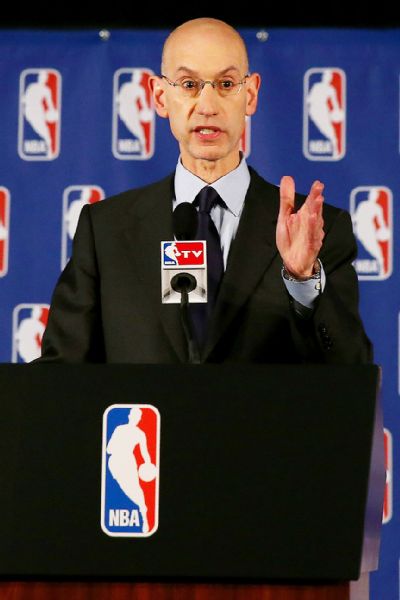
Elsa/Getty ImagesSilver needed to be certain it was Sterling's voice on the tapes.
He encountered widespread, long-simmering frustration. For years,
many in the league had felt there was nothing that could be done about
Sterling. He owned the team and the contracts. He had money, lawyers,
and a staggeringly self-delusional lack of shame and restraint. But you
simply shouldn't be allowed to say things like he said when you own a
team in a league that's mostly African-American. No, it was bigger than
that. You shouldn't be able to talk about other human beings like that
at all. By the time he had confirmation that the voice on the tape was
indeed Sterling's, Silver knew Sterling had to go. He also knew he
wasn't going to go easily.
Silver's first remarks Saturday were those of a lawyer. He was
cautious with his words, saying only as much as he knew to be true at
the time. Had this news conference not been scheduled long in advance,
Silver likely would have waited until he'd had a chance to gather more
facts. But canceling wasn't an option. The world needed to hear him.
Although he expressed outrage at Sterling's remarks, Silver also
reminded people that even the disgraced deserve due process. Not
everyone was impressed. Some said he came off as timid, or bookish. It
folded into the narrative of a longtime apprentice, not quite ready to
stand on his own yet. But those who knew him best were unfazed. Silver
had earned the respect of the owners during the 2011 NBA lockout. In
fact, many of them had wanted him to succeed Stern much sooner. Over the
next 24 hours, half a dozen owners issued statements condemning the
purported remarks of Sterling, and expressing their faith in Silver to
act on it. "We trust Adam," one owner said in the hours leading up to
his announcement of Sterling's ban.
The statement he would issue Tuesday had to be delivered, not
read. It was a moment for an orator, not a lawyer. The nation was
listening. Silver began slowly, reading the remarks he had prepared line
by line. Then he looked up and delivered the line: "Effective
immediately, I am banning Mr. Sterling for life." A seasoned actor could
not have performed it better. It was forceful. It was healing. It was
his moment.
"You gotta give Adam a lot of credit," one Clippers staffer said. "I didn't know if he had it in him."
A tone-deaf response
It's
funny what ends up getting you in the end. Al Capone went down for tax
evasion. Richard Nixon fell because his paranoia drove him to record
everything. The tapes of Donald Sterling became public because he and
his wife sue to get what they want, knowing most people don't have the
means to fight back.
The woman in the tapes, V. Stiviano, worked as his assistant for
four years. They'd met at the Super Bowl one year, hit it off and grew
closer. She traveled with him, went to meetings with him and was paid a
salary. Although she denies that they had a romantic relationship,
Sterling is described in court papers by her attorney as "a highly
public figure who is well known to be 'keeping women' other than his
wife and who has done so for very many years with a big toothy grin
brandishing his sexual prowess in the faces of the Paparazzi and caring
less of what anyone thought, the least of which, his own wife."
Sterling
lavished gifts on Stiviano over their four-year relationship, including
a 2013 Range Rover, a 2012 Ferrari and two Bentleys. He paid her rent.
He bought her jewelry. And, on March 7 of this year, Sterling's wife,
Shelly Sterling, sued her to get it all back.
Stiviano lawyered up. Her attorneys filed a response to the civil
suit, asking that the case be dismissed on April 21. Instead, Shelly
Sterling's attorneys requested that Stiviano turn over all tapes and
recordings made of herself and Sterling. The law compelled her to do so.
Four days later, the tapes surfaced publicly on TMZ.
On Monday of this week, Stiviano met with NBA investigator Anders
and verified that she and Sterling were indeed the ones on the tape,
which was recorded in September. She told them that Sterling knew he was
being recorded and that they often taped conversations because
Sterling, who sources say has been battling cancer
in recent years, forgets things, and explained that part of her job was
to help coach him on his image. On one of the tapes, a third person is
heard in the background. The NBA also interviewed that third person
before Silver made his ruling Tuesday, a fact that could be important
later if the legality of the tapes is questioned.
STERLING BANNED FOR LIFE

NBA commissioner Adam Silver banned Clippers owner Donald Sterling from the league for life, in the wake of Sterling's racist comments. Full coverage »
Sterling also spoke to Anders by phone and confirmed that it was
his voice on the tapes. Clippers team president Andy Roeser met with
Anders, as well. Silver kept in constant contact with Anders throughout
his investigation. He also consulted with several owners as he
deliberated. Time was of the essence. The scandal was dwarfing
everything, including an exciting, hard-fought first round of the
playoffs as well as announcements of the league's postseason awards
(which were postponed this week). The greatest part of the NBA season
was being sullied.
Sterling never seemed to
fully understand that the walls were caving in on him. Saturday was his
80th birthday. He and his wife stayed in San Francisco the entire
weekend. He was planning to go to the game on Sunday until Silver called
on Saturday and asked him not to. Shelly sat courtside and later flew
home on the team plane. Sterling and Roeser, who has worked for him for
over 30 years -- first at his real estate corporation, then with the
Clippers, watched the game together in San Francisco.
Roeser
was in an impossible position. On the one hand, his job was to serve
and counsel his boss. On the other, he knew what his boss had done and
said was deplorable. Roeser hired an outside consultant to help craft a
statement to respond to the tapes on Saturday. They discussed and
weighed three different messages. The first was to cop to everything.
Say that Sterling was sick, that he needed help, that he apologized and
felt terrible for offending anyone. The second was to dispute the
veracity of the tapes, question the motives of the woman on the tapes
and why they were released, and argue that what's said on them
misrepresents Sterling's true feelings. The third was to say very little
except that the team would cooperate with the NBA investigation. Roeser
felt the third message was the best option. Sterling did not. They went
with defiance, and they stuck Roeser's name on it.
"We have heard the tape on TMZ. We do not know if it is
legitimate or it has been altered," the statement read. "We do know that
the woman on the tape -- who we believe released it to TMZ -- is the
defendant in a lawsuit brought by the Sterling family alleging that she
embezzled more than $1.8 million, who told Mr. Sterling that she would
'get even.' Mr. Sterling is emphatic that what is reflected on that
recording is not consistent with, nor does it reflect his views, beliefs
or feelings. It is the antithesis of who he is, what he believes and
how he has lived his life. He feels terrible that such sentiments are
being attributed to him and apologizes to anyone who might have been
hurt by them. He is also upset and apologizes for sentiments attributed
to him about Earvin Johnson. He has long considered Magic a friend and
has only the utmost respect and admiration for him -- both in terms of
who he is and what he has achieved. We are investigating this matter."
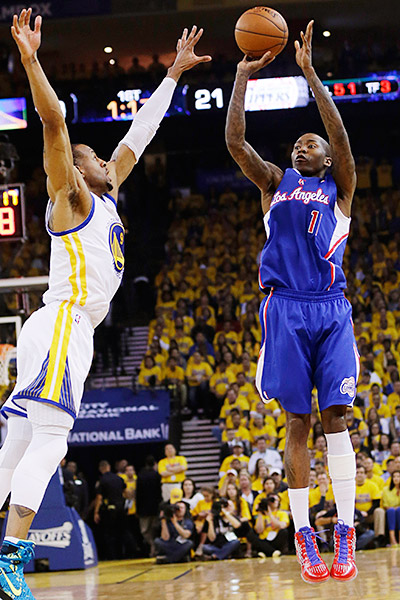
AP Photo/Marcio Jose SanchezJamal Crawford and his teammates searched for the appropriate response.
It was profoundly tone-deaf and widely decried. Rivers was
furious that the statement had been attributed to and released by a
representative of the organization for which he served as senior vice
president of basketball operations. It expressed a position neither he
nor any of the people he knew who worked for the Clippers -- including,
of course, the players -- held.
It served as a
breaking point for all of them. Over the next 24 hours, all the people
who worked for the Clippers began to distance themselves from Sterling.
The team's public relations staffers did whatever they could to protect
the players. Extra security was called in as tensions outside the hotel
and the arena escalated. They were hearing very little from the league
at this point. "We were kinda operating as a rogue franchise," one team
official said.
Roeser was always going to be the last one off the boat. After
watching the game with Sterling on Sunday afternoon, he flew home with
him to Los Angeles on a commercial flight.
Jimmy Goldstein, the famously ostentatious NBA fan seen sitting
courtside in leather pants and wild jackets at games all over the
country, was on the same flight from Oakland after the game.
"Donald was on the phone when I got on," Goldstein said. "So I didn't have to talk to him."
Too much, too soon
The Clippers never had much of a chance in Game 4. They basically just showed up to play.
Before the game, Matt Barnes had come up with the idea of turning their warm-up jerseys inside out as a statement against Sterling. Jamal Crawford
came up with the idea of wearing black socks and armbands. Other teams
followed suit that night to show their support. Kevin Johnson and the
players' union prepared to take concerted action if Silver did not act
quickly and decisively to punish Sterling. Team and league sponsors
began running for the hills. Boycotts were discussed for Tuesday night's
playoff games if Sterling were still in power by then.
The
pregame gesture was both inspiring and overwhelming, but within
minutes, it was clear the moment was too much for the Clippers to carry
alone. The Warriors thumped them 118-97.
Afterward, former Clippers guard Baron Davis
visited the team's locker room. He had gone to the game to cheer on the
Warriors, the team with which he'd had his best years as a pro. But he
wanted to check in on his former teammates in L.A., Blake Griffin and DeAndre Jordan, too.
Davis' time with the Clippers was a nightmare. Sterling heckled
him from the sideline, mocking him, cursing at him, embarrassing and
belittling him. Davis was the most expensive star player Sterling had
signed at the time, and, when he didn't perform the way Sterling had
hoped, the owner wanted to get rid of him. Throughout Davis' time with
the Clippers there were whispers that Sterling was looking for ways to
invalidate Davis' contract. No one would confirm the rumors at the time,
and eventually the Clippers just traded Davis to Cleveland, giving up
an unprotected first-round pick -- which turned into Kyrie Irving -- in the deal. Sterling wanted him gone, so it was done.
Davis declined to comment for this story. He had done a podcast for Grantland
five days before the TMZ report which was played in the immediate
aftermath of the scandal as reaction. But that was the least of it.
Sterling broke Davis -- his spirit, his love for the game -- for a time.
He was never the same player after his time in L.A. It's still hard to
talk about it.
One day he'll speak his truth. Tell people how deep this issue
really is. Explain that it can't be fixed in three days, no matter how
decisive the commissioner's decision. Everyone grabbing a microphone
right now is outraged by what they heard on a tape. Davis lived it.

AP Photo/David ZalubowskiDoc Rivers was angered by the team's statement questioning the authenticity of the recording.
'We Are One'
Rivers gave the
Clippers the day off on Monday, although most players came in for
treatment or a workout anyway. The team's media relations staff canceled
all player availability. You're not supposed to do that in the
playoffs, but at that point all that mattered was protecting the
players. Go ahead, fine them.
On Tuesday, the team gathered for its customary gameday
shootaround at 10 a.m. PT. Silver's ruling and news conference was set
for 11 a.m.
The Clippers did not watch.
After 72 hours of chaos, Rivers brought the focus back to
basketball. This was their team now, not Sterling's. This was their
playoff series, their Game 5, their championship dream.
A league representative called Roeser a few minutes before 11 to
inform him that Sterling would be banned for life from the NBA and fined
the maximum $2.5 million and that Silver would be urging the league's
board of governors to move quickly to strip him of his ownership and
force a sale. Roeser quickly wrote up a note and had it delivered to
Rivers down on the practice court. Rivers opened it, read it and put it
in his pocket. The Clippers continued with their practice.
The Warriors were the enemy again. Basketball was what mattered.

Andrew D. Bernstein/NBAE/Getty ImagesChris Paul and the Clippers bounced back in Game 5.
Outside, cars honked their horns as they drove by the Clippers'
facility. It felt like one of those days the whole city was watching and
waiting on the same thing together. Like when the verdict in a huge
celebrity trial is read or election results are announced. People in Los
Angeles are used to being disappointed on days like this. The cops who
beat up Rodney King were acquitted, and the city rioted. But on this
day, Silver gave the people what they wanted.
"Adam did react swiftly, and it was a great day for everyone,"
Paul said. "We're happy about moving forward. ... It seemed like a
burden was lifted off of everybody and we could get back to playing
basketball."
The Clippers won going away 113-103.
Near the end of the game, Rivers walked along the Clippers'
bench, giving each one of his players a high-five. At the end of a very
long week, he allowed himself a moment to enjoy it. His focus had been
entirely on his players -- on protecting them, supporting them, fighting
for them. Now, he allowed himself a little fist pump. Like Tiger Woods
sinking a long putt. This felt good.
It had been a bizarre night. Protests had been planned, then
canceled after Silver brought down the hammer. Sponsors had canceled or
suspended their associations with the team, so the entire arena had been
tarped in Clipper blue. Instead of advertisements, one message remained
on the scoreboards throughout the game.
"We Are One."
Every Clippers staffer, from general manager Gary Sacks to the
team's PR staff, had dressed in black to show unity. Fans wearing
T-shirts with a line through Sterling's face were shown on the video
board.
"We might just keep it that way," one Clippers official said. "I thought it was an incredible in-game atmosphere."
C.J. Paul lingered awhile after the game, chatting with friends. He was drained. They all were.
After 45 minutes, arena personnel started taking down the
Clippers banners, revealing the old ads underneath. The moment was
passing. But the world had changed.
"I'm going to be real: We've been here for, what, three years? I
haven't talked to Donald Sterling once. Not one time," C.J. Paul said.
"When Chris got traded here, we didn't come here for Donald Sterling. We
came to win a championship for Los Angeles."
The call
Roeser called Sterling to tell him Silver was banning him from the NBA for life. It was a short call.
Roeser and Shelly Sterling are the two alternate governors for
the Clippers, and for the time being Roeser will run the day-to-day
operations of the team. But the NBA will act swiftly, likely appointing a
trustee to oversee the team and moving to force a sale quickly. Those
who know Sterling expect him to fight in court.
"Knowing him, I would think the first thing is, 'How do I fight
it? What is the legal strategy here?'" said Steve Soboroff, a civic
leader, a longtime Clippers season-ticket holder and the driving force
behind the building of Staples Center in Los Angeles.
"Sterling
has never sold anything. I don't even think he sells his used cars. So
this is against his nature. But I believe the way they set it up, so
strongly, that he can't even make decisions having to do with money,
having to do with the team, that he cannot continue to own it and
eventually he'll see that.
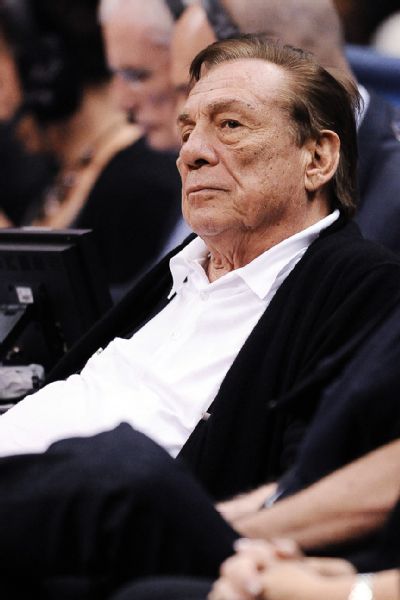
Jayne Kamin-Oncea/USA TODAY Sports In the end, Sterling was both the center of attention and in exile.
"When he sees that, that he is banned, he'll realize the sooner
he gets rid of it, the better it will be for him. And that's what he's
always concerned about."
Sterling was at his
home in Beverly Hills when Roeser called Tuesday morning. He owns two
mansions in Los Angeles. The other is in Malibu, overlooking the Pacific
Ocean.
Sterling's parties are legendary in Los Angeles. Every September
he throws a "White Party" at the house in Malibu. Guests are told to
wear white -- a fashion faux pas after Labor Day. Sterling is the only
one in black. He hires gorgeous hostesses to entertain and serve at
these parties. He tells his players to attend, as well, so his guests
can meet them and take pictures. As always, they are part of the
entertainment provided by the gracious host. He liked to be called Mr.
Sterling. Loved to be the center of attention.
But when the end came for Donald Sterling, he was alone. There
was no party. There were no guests. There was only a phone call and the
guy he had paid for 30 years to serve him saying he'd been kicked out of
the league.
"It's hard to have a moral compass as an owner," said a longtime
Clippers employee. "There's no one there to check you except the other
owners."
Courtesy of ESPN.com

Walang komento:
Mag-post ng isang Komento